
"A vocation to the arts often manifests itself in the very young. This curriculum will finally provide parents and educators with a serious course of study suitable for forming future artists, craftsmen, and godly men and women of culture."
--Gwyneth Thompson-Briggs, Catholic Artist and Educator
A Unique Art Curriculum
Art Education Through Religion was developed in the late 1920s by Mary Gertrude McMunigle, who was Director of Art for the Diocese of Pittsburgh at the time, and her curriculum was overseen by two priests: Rev. Paul E. Campbell, A.M. LitD, who was then superintendent of Parochial Schools for the Pittsburgh Diocese, and Rev. Raymond V. Kirk, A.B. PhD, Dean of the College of Education of Duquesne University. So this series actually has an Imprimatur!

Building Character with Skill
Each lesson aims to improve the student’s artistic skill, but at the same time, the lesson contains an underlying spiritual objective and a character objective.
Thus not only the eye is trained, but the whole person, including the intellect and will. Students gain knowledge, self-control, accuracy, reverence, helpfulness and good manners, as well as many other useful life skills.
Learning to See
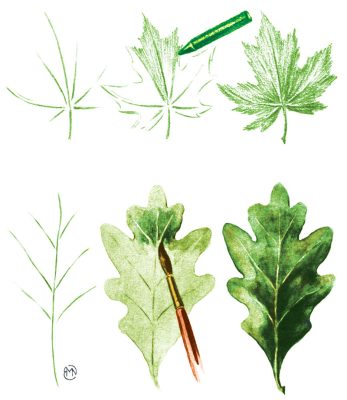
These are not merely “busywork” craft projects that require extensive preparation. Each task, from the simple to the complex, progressively builds a student’s skill in how to see, and how to accurately represent what he or she sees.
Repetition of these exercises leads to the development of muscle memory as well as development of intellectual and aesthetic strength.

Scope of the Program
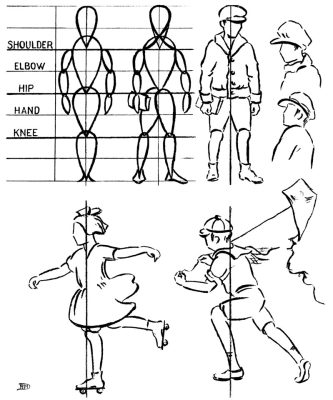
The broad range of media and skills taught include pencil drawing, coloring, paper cutting and folding, booklet making, molding with clay, painting, lettering, graphic design, color theory, composition, proportion, conventionalizing, and art appreciation.
And yet the supplies needed are not exotic or costly: pencils, crayons, paper, scissors, glue, a ruler, watercolors and a paintbrush, modeling clay…after all, this curriculum was developed during the Great Depression. There are many creative suggestions for homemade and recycled materials.
Optional Add-on:
Art Appreciation Readers
There is an emphasis on picture study at each grade level to reinforce the student’s eye training. The teacher’s manual contains suggestions for this picture study. However, a series of readers called Great Pictures and Their Stories was produced by the same publisher, containing more or less exactly those same works. Each grade has very age-appropriate artwork and descriptions of those works with attention to subject, light, color, composition, and details about the artist.

Art Matters
Because Beauty Matters
The appreciation and creation of art contribute not only to the skills and culture of an individual; they are an invaluable means for internalizing the beauty of God’s Creation for the purpose of beautifying the soul.
Frequently asked questions
We wondered this too when we first looked at the original books. Having been printed during the Great Depression, the paper and printing were very dull and drab, and we feared the expectations were too high, especially for the youngest children.
However, we have spent a great deal of time painstakingly restoring, redrawing and recoloring the pages of the student books to make them vibrant and appealing.
Moreover, during the 2024-25 school year, we initiated a pilot program that included several homeschooling families as well as two elementary schools. These volunteers tested the curriculum with their students, and the feedback was overwhelmingly positive!
While the challenges set before the students can seem daunting at first, they are the right kind of challenges, and they effectively build muscle memory and eye-hand coordination. They also don’t require mom to do all the hard work, or result in a house filled with popsickle sticks! Let the kids have fun working through honing their skillset, and they will steadily improve!
While many curricula are tied specifically to grade levels, the system of eye training taught by this series begins in the early grades, each level building upon the foundation laid in the one previous. The student’s level in this curriculum does not need to correspond to his grade level. That being said, the earlier books are definitely geared for a younger audience.
So while an 8th grader may find Book One far too babyish for his tastes, he will certainly be confused by the instructions in Book Eight, as they refer to concepts taught in earlier levels.
Therefore we strongly recommend that students who have not used this curriculum at the younger ages begin with a book that is at least one or two levels behind his or her current grade level, and for older students, please do not begin at a level above Book Five.
Learn more about what is taught at each level here.
We hope to put together pre-assembled supply lists soon, through an online art supply store such as Dick Blick, in order to make acquisition of these materials as simple as possible.
However, for the most part, the necessary supplies are ones you may already have: paper, scissors, glue, pencils and crayons, a standard watercolor tray and modeling clay. The teacher’s manual has suggestions for how to make your own paste, and other tips for repurposing easily accessible supplies.
The eight student books and teacher’s manual, as well as the Great Pictures and Their Stories readers, are now ready and can be purchased at St.Augustine Academy Press!
Comments from our Pilot Program
During the 2024-2025 school year, a number of volunteers agreed to test this curriculum with their students. Here is a small selection of their feedback so far:
I loved her use of liturgical colors and symbols within lessons, and that it followed the liturgical year with beautiful ideas for Mary and Joseph's feasts, alongside the major feast days of the Church. Lessons were able to be extended into many weeks of work or used in partial to teach certain principles.
It was invaluable to read through the whole introduction to get a full understanding of her program and how/what materials are best used.
My older kids loved doing projects on all levels of the program. They found joy and excitement in the projects. I plan to use it again both in the school and as a homeschooling parent this coming year.
The depth of explanation in the Teacher's Manual, particularly for spiritual objectives, is what makes this curriculum stand out as something classical, thorough, and devotional in the best sense.
I especially loved the questions about observing masterpieces of art: "Where is the little boy? What time is it? Where is the light coming from?" These questions teach children to SPEND TIME with a painting, to begin with objective observations, and to develop a sense of wonder.
Some of my favorite projects were the clay projects and the watercolor paintings from real life. I appreciated the nice tidbits of advice, such as using the weight of the hand to manipulate the brush to achieve different sizes of strokes, how to paint with pure color and not muddy ones brush, how to choose the right size of paper in relation to the subject being painted, and especially the directive to use real plants/models for drawing.
Overall, the curriculum was successful for both of my kids!"
I do appreciate that it's fairly open-ended and I can adapt things on the go, as the day requires. I love how concise the lessons are too, and it really doesn't take up too much time (a common pitfall with homeschool curricula). I love that it's mostly open and go as well. I don't have to sit around prepping piles of materials before each lesson.
In particular, the detailed painting tips have really helped my 5th grader, and my 3rd grader was challenged in such a good, healthy way with the graph paper copy-work focusing on detail and accuracy. There's some really fun and unique projects included all throughout these books that I never would have come up with on my own, and we're just loving it.
I must say too, the "Great Pictures and Their Stories" books are such a lovely addition to the coursework! The kids are really enjoying them. These are such a treasure."